


By: Jordan Kleinecke
There is a saying around our shop that sums up a lot of how we see the industry: a building does not perform because you say it will. It performs because you prove it will. That proof comes through testing, real, measurable, boots-on-the-ground, data-in-the-lab testing.
Why the Word Performance Matters
You can build something that stands up and passes inspection. That is a standard building. But if you want it to thrive, maintaincomfort, efficiency, and durability throughout decades of heat, wind, weather events and water, you have entered another league.
High-performance design is not just about new materials or technologies. It is about discipline. The discipline to challenge assumptions, question every joint, and verify every seal. It is what drives building envelope commissioning and testing, ensuring that the promises made in drawings are the realities built in the field.
Beyond the Ribbon-Cutting
Many projects celebrate success the day the ribbon is cut and the lights come on. But true performance is not proven on Day One. It is measured in year ten or year twenty. That is when the value of air and water infiltration testing shows up.
Buildings that have gone through rigorous testing hold their ground through countless weather cycles, while others start showing signs of fatigue. Testing transforms the lifecycle of a building. It is not about compliance. It is about confidence.
The Orchestra, Not the Solo
A high-performing envelope is not a solo act. It is an orchestra. Each section of the building is playing their own part or instrument. There is the facade performance evaluation section, the commissioning section, the inspection section, and the testing section. Each has its own rhythm, and when they work together, the result is harmony.
Testing is vital, but it is only one section of the score. Peer reviews, QA/QC, and design validation play their own parts. You cannot cut corners because you do not have a certain skill in house. You bring in the right experts, you collaborate, and you compose a process that delivers total performance.
The Four Pillars of Building Performance Testing
We view building performance testing as a system supported by four key pillars. Miss one, and you are inviting long-term problems. Nail all four, and you have a building that earns its reputation.
1. Design Validation: Before construction begins, plans are reviewed for constructability, integration, and performance. The goal is to confirm that the design meets high-performance building standards and real-world durability expectations.
2. Field Verification: During construction, materials and assemblies are inspected for accuracy. Every detail counts.
3. Performance Testing: This is the heart of it. Through air and water infiltration testing, curtain walls, windows, and facades are subjected to simulated wind and rain conditions. These tests expose weaknesses before the building does.
4. Ongoing Evaluation: Performance does not stop at project closeout. Post-occupancy facade performance evaluation ensures the building performs as designed through seasons and years.
The Mindset Behind the Metrics
Too often, testing is seen as a hoop to jump through, a requirement and not a resource. But world-class teams think differently. They see building performance testing as the moment of truth. When a facade fails, it is not a setback. It is a signal. It is a data point that protects the owner, saves money, and elevates future work.
That mindset changes everything. Because when your team takes ownership of testing, they stop working to meet code and start working to exceed it.
The Bottom Line
Every building tells a story. Some are stories of shortcuts. Others are stories of endurance. World-class projects do not happen by accident. They happen when envelope commissioning and testing become part of the culture, not a checklist.
When you invest in true building performance testing, you are not just checking compliance boxes. You are building resilience. You are buying proof of performance and longevity that standard testing cannot deliver.
NABCTA’s network of certified professionals brings deep expertise across building performance testing, facade performance evaluation, and air and water infiltration testing. From laboratory testing and field analysis to forensic investigation, our member firms close the loop between design intent and long-term reality.
Become a member of NABCTA for free and stay in loop on all things BECx. Join HERE.
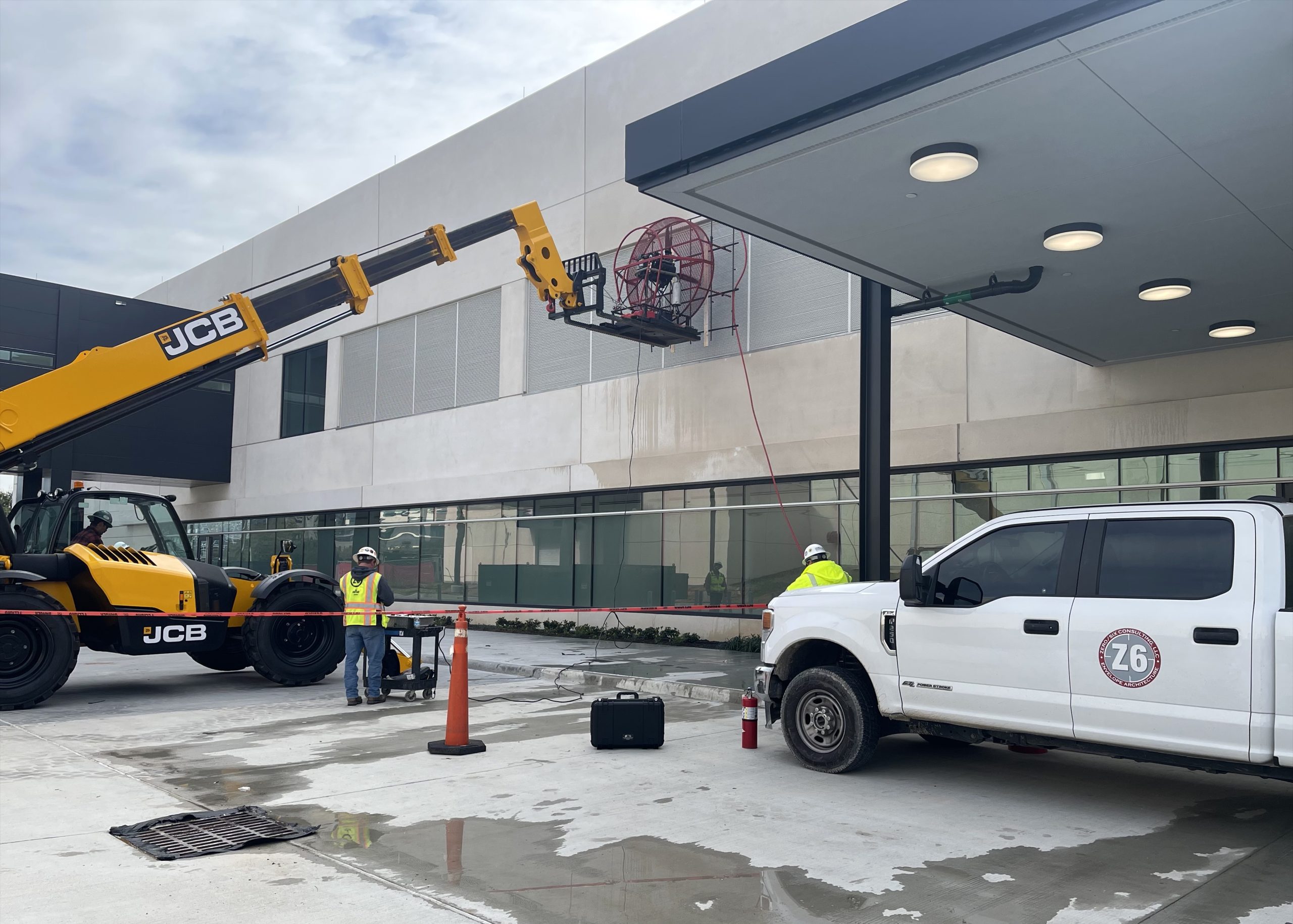
Testing in photo being conducted by Zero/Six Consulting, LLC.
Frequently Asked Questions (FAQs)
What is building performance testing?
Building performance testing is the process of verifying that a structure performs as designed through measurable, documented evidence rather than assumptions. It covers everything from air and water infiltration testing on facades and windows to structural load testing and thermal analysis. The core principle is simple: a building does not perform because you say it will. It performs because you prove it will.
What are the four pillars of building performance testing?
The four pillars are design validation, field verification, performance testing, and ongoing evaluation. Design validation happens before construction and confirms the plans can actually deliver the intended performance. Field verification happens during construction and checks that materials and assemblies are installed correctly. Performance testing subjects the finished building to simulated real-world conditions. Ongoing evaluation continues after occupancy to track how the building holds up over time.
What is the difference between laboratory testing and field testing for buildings?
Laboratory testing validates design intent before construction begins. It subjects mockups and assemblies to controlled conditions — air infiltration, structural load, water infiltration — to confirm they can meet performance targets. Field testing verifies workmanship once the building is built. Manufacturer test data tells you what a product can do under ideal conditions. Field testing tells you what actually happened on your job site. You never rely on one without the other.
What does air and water infiltration testing involve?
Air infiltration testing measures how much air moves through a wall, window, or building assembly under pressure. Water infiltration testing uses controlled water spray at specific pressures to simulate wind-driven rain conditions. Both tests expose gaps, missed sealants, failed transitions, and sequencing errors that visual inspection cannot find. Common standards include ASTM E283 for air, ASTM E331 for water, and ASTM E330 for structural performance.
What is facade performance evaluation?
Facade performance evaluation is a systematic review of a building’s exterior envelope to assess how it is holding up against weather, thermal movement, and age. It typically includes visual inspection, field testing, and documentation of any deterioration or performance drift. It is most valuable as a recurring program rather than a one-time event, since it gives owners a baseline to measure against and catches problems while they are still manageable.
How often should a building be tested after occupancy?
There is no universal rule, but buildings in high-exposure climates or with complex envelope systems should be evaluated periodically — typically every three to five years, and always after a major weather event. A building that passed testing at occupancy may perform differently after a few seasons of thermal cycling, UV exposure, and material aging. Post-occupancy evaluation is the only way to know the difference between a building that still performs and one that just looks like it does.
Why is manufacturer test data not enough?
Manufacturer test data is generated under controlled lab conditions using idealized specimens. On a real job site, field conditions, sequencing, penetrations, and workmanship introduce variables that lab testing never accounts for. A window that passes air and water infiltration testing in a lab can still fail in the field if the installer did not properly tie the WRB into the weather seal. Field tests verify workmanship. That is what manufacturer data cannot do.
What separates a world-class building from a standard one when it comes to testing?
Standard buildings pass the inspections required to get a certificate of occupancy. World-class buildings treat testing as a continuous process, not a closeout checklist. They validate designs before construction, verify installation in the field, test the finished envelope under realistic conditions, and evaluate performance over time. The difference shows up not at ribbon-cutting, but in year ten, when the standard building is chasing leaks and the world-class one is not.